EN
EN  IT
IT  ES
ES  FR
FR In short. Fertigation is the distribution of fertilizers dissolved in the irrigation water, usually using drip or microirrigation systems. It allows the crop to receive the right dose of nutrients at the time they are needed, reducing waste and losses. To do it well, pure water-soluble fertilizers are needed and a plan that changes the ratio of nitrogen, phosphorus, and potassium throughout the cycle.
In horticultural companies, irrigated orchards and greenhouse crops that we follow, fertigation is now the technical standard. Yet we often see very different results with the same plant spacing. The difference is due to three choices: the formulation, the concentration of the solution, and the sequence of applications during the cycle.
In this guide we collect what we have learned from years of field testing and technical assistance to companies.
What is fertigation and why we recommend it
With fertigation, the nutrients reach the active root zone already as a solution. Compared to traditional splash-fertigation, for a professional company the benefits are tangible:
- Higher level of efficiency of use. Less nutrients are lost through leaching, volatilization or immobilization in the soil.
- Fractional doses. The crop receives small amounts frequently, in line with its absorption rate.
- Nutrition for the phenological phase. We can shift the ratio of nitrogen, phosphorus and potassium as the plant progresses from germination to flowering, thickening and maturation.
- Operational savings. No additional steps are needed in the field: fertilization and irrigation take place together.
- Control and traceability. The quantities distributed in each turn are known, which is an advantage for the campaign booklet and for the production manuals.
How fertigation is done: planting and parameters
A fertigation system consists of a water source, an injection system (dosing pump, Venturi injector, or automatic fertigation system), a group of filters, and a drip or microirrigation distribution network.
When we partner with a company, the parameters we monitor are the following:
- Concentration of the solution. For our water-soluble fertilizers, we indicate 1-2 grams per liter, that is, 1-2 kg per cubic meter of water, in a sleeve or in microirrigation.
- Electrical conductivity (EC). It measures the salinity of the solution. Values too high stress the roots, especially in sensitive crops and in greenhouses.
- pH of the solution. A slightly acidic pH favors the availability of microelements and reduces the risk of precipitation that clogs the drippers.
- Water quality. Hardness, bicarbonates and sodium influence the choice of formulations and the eventual need for acidification.
- Sequence of the turn. We recommend starting with clean water, injecting the fertilizer into the center of the row and closing it again with clean water to wash the lines.
What fertilizers do we use for fertigation
In fertigation, highly pure, completely soluble, low-chlorine fertilizers are needed, free of insoluble residues. Our line of water-soluble fertilisers It covers all the phases of the cycle. The titles of the line Nutrytech They also incorporate our Micro Active Complex technology, a microbial inoculant that supports the development and functionality of the roots.
| Formulated | Phase in which we recommend it | Why? |
|---|---|---|
| 12.48.8 | Transplantation, rooting, pre-flowering | Very high phosphorus (48%) for roots and flowering, with boron, iron, manganese and zinc |
| 30.10.10 | Vegetative growth | Nitrogen predominant for the development of leaves and buds |
| 20.20.20 | Maintenance phases | Balanced formula to support growth without imbalances |
| 8.24.24 | Flowering and fruiting | Phosphorus and potassium for flowers and early fruits |
| 9.18.27 | Aggregation and enlargement | Potassium increasing, phosphorus still supported |
| 15 5 30 | Growth and maturation | Potassium at 30% per piece, in terms of color and flavor, with readily available nitric oxide |
The product sheets for each product are available here: 12.48.8, 30.10.10, 20.20.20, 8.24.24, 9.18.27, 15 5 30.
To complete the plan, our liquid microelements They correct specific deficiencies of iron, manganese, zinc or boron, which are frequent on limestone soils or with hard water. We discussed this in the articles on ferric chlorosis and on manganese in plants.
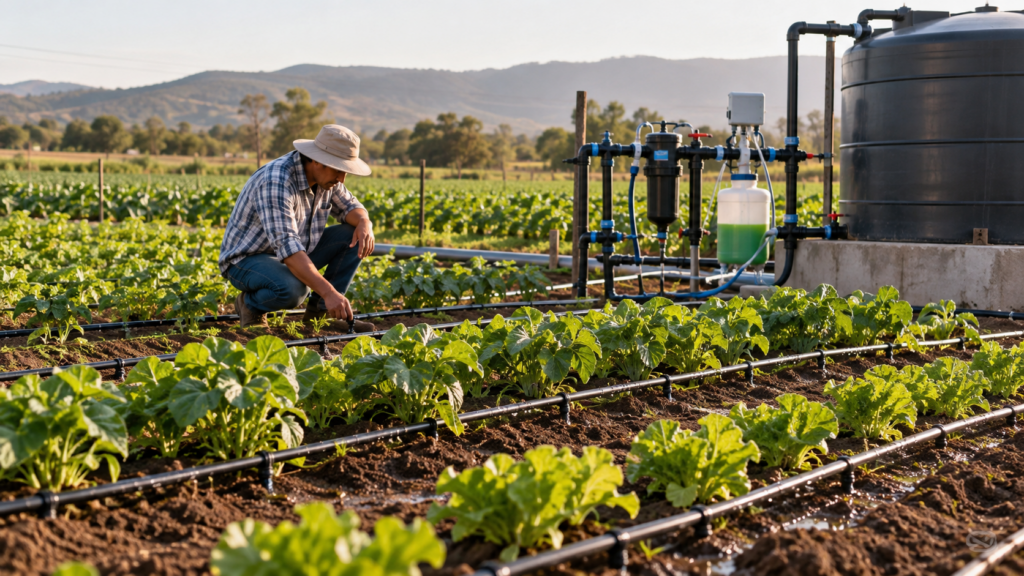
An example of our fertigation plan for fruit-bearing crops
Here is the scheme we propose as a base for tomatoes, peppers or aubergines, in the open field or in the greenhouse. The quantities must always be adapted to the analyses of the soil and water and to the expected yield.
- Transplantation and attachment (1-3 weeks). We use 12.48.8 to stimulate the roots. The indicative dose for fruit vegetables is 3-4 kg per 1,000 m², distributed over the period.
- Vegetative growth. We move on to 30.10.10 or 20.20.20, depending on the strength of the crop.
- Flowering and fruiting. We use 8.24.24 to support flowers and early fruits.
- Enlargement. We use 9.18.27 and then we switch to 15 5 30.
- Maturation. We conclude with 15 5 30 for color, sugar content and shelf life.
For arboreal crops such as vines, fruit trees, citrus, olive trees and actinidia, we apply the same principle on a seasonal scale. For 12.48.8 and 15 5 30, the doses we indicate range from 60-80 kg/ha for apple and pear trees to up to 120-130 kg/ha for olive trees, to be applied throughout the growing season.
Fertigation and biostimulation: how to combine them
The fertigation system is also the most efficient channel for distributing radical biostimulants and microbial inoculants. By combining nutrition and biostimulation, we help the crop absorb nutrients better, support the roots in heat and salinity stress, and in many cases, we are able to reduce the number of fertilizer units required.
For further information, we refer you to our line of biostimulants, and the article on how to overcome it heat stress and drought.
The errors we see most often in fertigation
- Mix incompatible fertilizers in the tank, for example calcium with sulfates or phosphates, which form precipitates.
- Working without measuring the electrical conductivity and pH of the solution.
- Use formulations with insoluble residues, which clog filters and drippers.
- Maintain the same NPK content throughout the entire growing cycle.
- Forget about the final wash of the lines at the end of the shift.
Let's build your fertigation plan together
Our technicians build the program based on analyses of the water and soil, the crop, and the company’s production goals. Contact us or register to download the technical sheets for our water-soluble fertilizers.
Frequently asked questions about fertigation
What is fertigation?
This is the technique that distributes the fertilizers dissolved in the irrigation water, usually using drip or microirrigation systems. The nutrients are delivered in solution directly to the active root zone.
What fertilizers are used for fertigation?
Fully water-soluble, highly pure and low-chlorine fertilizers, such as our NPK 12.48.8, 20.20.20, 15 5 30. The grade is chosen based on the stage of the crop.
What concentration should be used in the fertigation solution?
For our water-soluble fertilizers, we recommend 1-2 grams per liter, that is, 1-2 kg per cubic meter of water. It is also important to check the electrical conductivity to avoid stressing the roots.
What is the best fertilizer for tomato fertigation?
There is not just one. We recommend a phosphate fertilizer like 12.48.8 for transplanting, more nitrogen-rich or balanced growth formulas, and potassium-rich formulas like 15 5 30 for thickening and maturation.
How often is fertigation done?
It depends on the crop, stage and type of soil. Generally, we intervene every irrigated cycle or several times a week with low doses, splitting the total amount planned for the cycle.