EN
EN  IT
IT  ES
ES  FR
FR Calcium deficiency in plants is a nutritional problem that can have significant consequences on crop quality and productivity. Blossom-end rot, bitter pit, desiccation and fruit firmness issues are some of the symptoms that can be associated with insufficient calcium supply in plant tissues.
A particularly important aspect is that the deficiency does not always depend on the total amount of calcium present in the soil. Under certain conditions, in fact, the element may be present but fail to reach in sufficient quantities the organs that have the greatest need for it.
For this reason, we at MS Biotech consider calcium management as part of a wider nutritional strategy, which must take into account the crop, the phenological stage, irrigation and environmental conditions.
Let's look at how to recognise a calcium deficiency, what the causes might be and how to prevent its consequences.
What is calcium used for in plants?
Calcium is an essential element for plant development. It participates in the formation and stability of cell walls and contributes to the structure and resistance of tissues.
An adequate availability is therefore particularly important during phases characterised by intense cell growth, such as the development of new tissues and fruit growth.
Calcium also plays a role in numerous physiological mechanisms and in the processes through which the plant perceives and responds to specific environmental stimuli.
We have already explored this in depth in our dedicated article “The importance of calcium for plants” the main physiological functions of this element. In this in-depth look, however, we want to focus on a more practical problem: what happens when calcium does not reach plant tissues in adequate quantities.
How to recognise a calcium deficiency in plants
Symptoms can vary considerably depending on the crop.
Calcium has limited mobility within the plant and is transported mainly through the transpiration stream. For this reason, problems can manifest especially in young tissues and in organs characterised by relatively low transpiration, such as fruit.
Among the signs we can observe are:
- necrosis of young tissues;
- leaf distortion;
- reduced development of vegetative apices;
- fruit firmness problems;
- desiccations;
- cracks;
- emergence of specific physiopathies.
It is important not to automatically attribute every symptom to a calcium deficiency. A correct diagnosis must consider the nutritional status of the crop, soil conditions, irrigation management and any other stress factors.
Why can calcium be deficient even when it is present in the soil?
This is one of the most interesting aspects from an agronomic point of view.
Having calcium in the soil does not necessarily mean that every part of the plant receives a sufficient amount.
Calcium transport heavily depends on the movement of water through the plant. Consequently, conditions that alter root uptake or transpirational flow can create problems in the distribution of the element.
For example, irregular irrigation management can alternate periods of high water availability with periods of stress, making the supply of calcium to growing tissues less constant.
High temperatures, high humidity, salinity, root problems and imbalances between nutrient elements can also influence the situation.
For this reason, the management of calcium deficiency should not be simply reduced to the question: “how much calcium am I taking in?”
We must also ask ourselves how much calcium the plant is actually able to absorb and, above all, to transport towards the organs that need it.
Blossom end rot of tomato and calcium deficiency
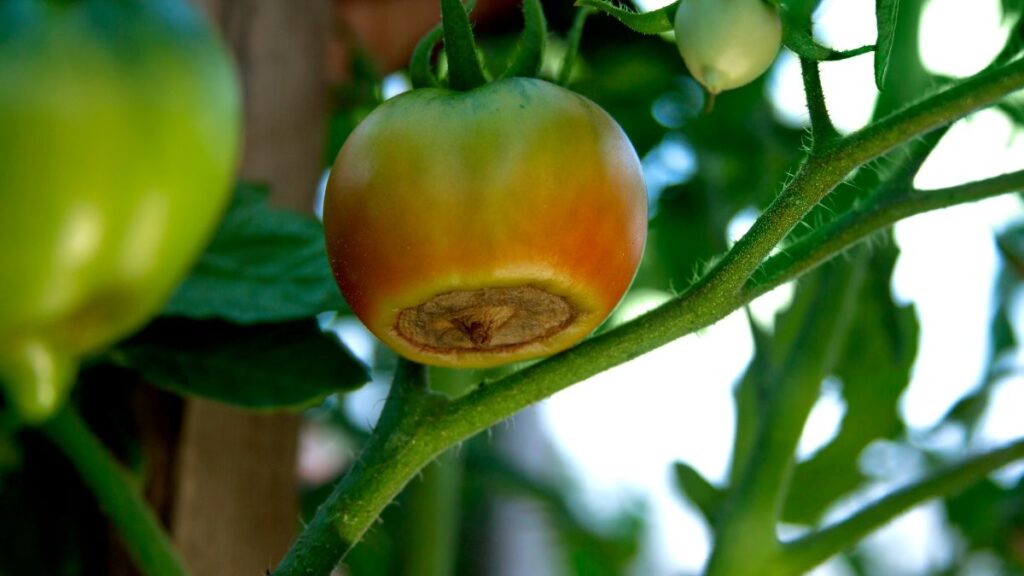
One of the best-known examples is the apical tomato rot, a physiological disorder characterised by the appearance of a dark, necrotic area in the apical zone of the fruit.
The issue is associated with an insufficient availability of calcium in the fruit tissues, but it does not necessarily mean that the soil is poor in this element.
Water stress and sharp variations in water availability can play a decisive role.
This is the reason why a correct strategy must consider calcium nutrition and irrigation management simultaneously.
Similar issues may also affect sweet peppers and other horticultural crops.
Bitter pit
Another physiopathy closely associated with calcium nutrition is bitter pit in apples.
It manifests itself through small depressions on the fruit's surface, which correspond to alterations in the underlying tissues.
The problem can also become particularly evident during storage, affecting the commercial quality and shelf life of the harvest.
For fruit companies, therefore, the correct management of calcium does not only concern what happens in the orchard, but can also influence the behaviour of the fruit during post-harvest.
Calcium, fruit firmness and shelf life
The structural role of calcium explains why this element is also so important for the final quality of the yield.
Properly developed plant tissues can exhibit greater mechanical resistance and a better texture.
For productions intended for storage and marketing, this aspect takes on particular importance.
Calcium nutrition must therefore be considered not merely as a tool for preventing certain physiological disorders, but as part of a strategy aimed at the overall quality of the harvest.
How to prevent calcium deficiency
Prevention starts with a balanced agronomic management.
Before intervening, it is useful to know the characteristics of the soil and the crop through periodic analysis and monitoring. Water management is also fundamental: regular irrigation helps maintain a more consistent flow of water and nutrients to the plant.
We must also pay attention to nutritional imbalances. The excess of certain elements can interfere with the absorption and distribution of other nutrients.
Finally, in particularly sensitive crops and stages, we can supplement normal nutrition with targeted calcium applications.
Veratech Ca: our support for calcium nutrition
To support crops during their greatest phases of need, we have developed Veratech Ca, a liquid foliar fertiliser from the Veratech range, based on calcium chloride, containing 15.6% of water-soluble calcium oxide (CaO).
Thanks to its formulation, Veratech Ca promotes calcium absorption through the tissues and its translocation within the plant.
The product is indicated for various crops for the prevention and management of physiological disorders associated with calcium deficiency, including bitter pit in apples, blossom-end rot in tomatoes, tip burn in lettuce, rachis desiccation, physiological desiccation and fruit splitting.
Calcium intake also contributes to the mechanical strength of plant tissues, fruit firmness, the crispness of leafy vegetables and the shelf life of the produce.
Veratech Ca is applied via the leaves and can be included in the nutritional programme depending on the crop and the production stage, always following the dosages and methods of application given in the technical data sheet.
When to intervene with football?
Waiting for the clear appearance of a disorder does not necessarily represent the best strategy.
In crops historically subject to calcium availability problems, it is preferable to adopt a preventive approach, scheduling applications during the stages of highest demand.
Particular attention must be paid to the fruit development and enlargement phase, during which correct nutrition contributes to the formation of firm, high-quality tissues.
Climatic conditions must also be monitored: periods characterised by high temperatures or sharp variations in water availability can alter the plant's ability to distribute calcium correctly.
Conclusions
Calcium deficiency in plants is a more complex issue than it might seem. It does not depend exclusively on the amount of the element present in the soil, but also on the plant's ability to absorb it and transport it towards growing tissues.
Blossom-end rot, bitter pit, tip burn, desiccation and splitting are some of the problems that can indicate inadequate calcium nutrition.
For us at MS Biotech, the best strategy therefore starts with prevention: correct irrigation management, nutritional balance, crop monitoring and targeted interventions during the phases of highest demand.
With Veratech Ca we can supplement the nutrition through a specific foliar calcium application, helping to support firmness, resistance and commercial quality of the produce.
To learn more about all the physiological functions of this element, we also recommend reading our in-depth article “The importance of calcium for plants”.
FAQ on calcium deficiency in plants
How to tell if a plant has a calcium deficiency?
Symptoms can include necrosis of young tissues, leaf deformation, problems with growing tips and specific fruit disorders. However, the manifestation varies according to the crop and must be evaluated in conjunction with agronomic conditions.
What are the main disorders associated with calcium deficiency?
Among the best known are blossom-end rot in tomatoes and peppers, bitter pit in apples, tip burn in leafy vegetables, and certain forms of fruit desiccation and splitting.
Why is there a calcium deficiency in the tomato plant even if the soil contains it?
Why the problem may depend on the distribution of calcium within the plant and not necessarily on its absence in the soil. Water stress, irregular watering and other factors can limit the arrival of calcium to the fruit.
When should you fertilise plants?
It depends on the crop and the nutritional programme. In crops prone to deficiency-related physiological disorders, it is generally preferable to adopt a preventive strategy, intervening during the stages of highest demand rather than waiting for symptoms to appear.
What is Veratech Ca used for?
Veratech Ca It is a liquid foliar fertiliser based on calcium chloride, containing 15.6% water-soluble CaO. It is designed to supply calcium to crops and help prevent and manage physiological disorders associated with calcium deficiency, as well as to improve the texture and shelf life of the produce.